I recently bought an LCR meter and wanted to measure the parameters of various capacitors and inductors on hand for comparison.
The test equipment is a Zhongchuang ET4410, and the measured parameters include: capacitance, inductance, D (dissipation factor), Q (quality factor), ESR (equivalent series resistance), and X (reactance, usually expressed as inductive reactance XL or capacitive reactance XC).
Full Excel table download link: https://url.zeruns.com/1W8cW
Zhongchuang ET4410 Benchtop LCR Digital Bridge Brief Unboxing & Review: https://blog.zeruns.com/archives/763.html
RIGOL DHO914S Oscilloscope Brief Unboxing & Review: https://blog.zeruns.com/archives/764.html
Electronics / Microcontroller Tech Group: 2169025065
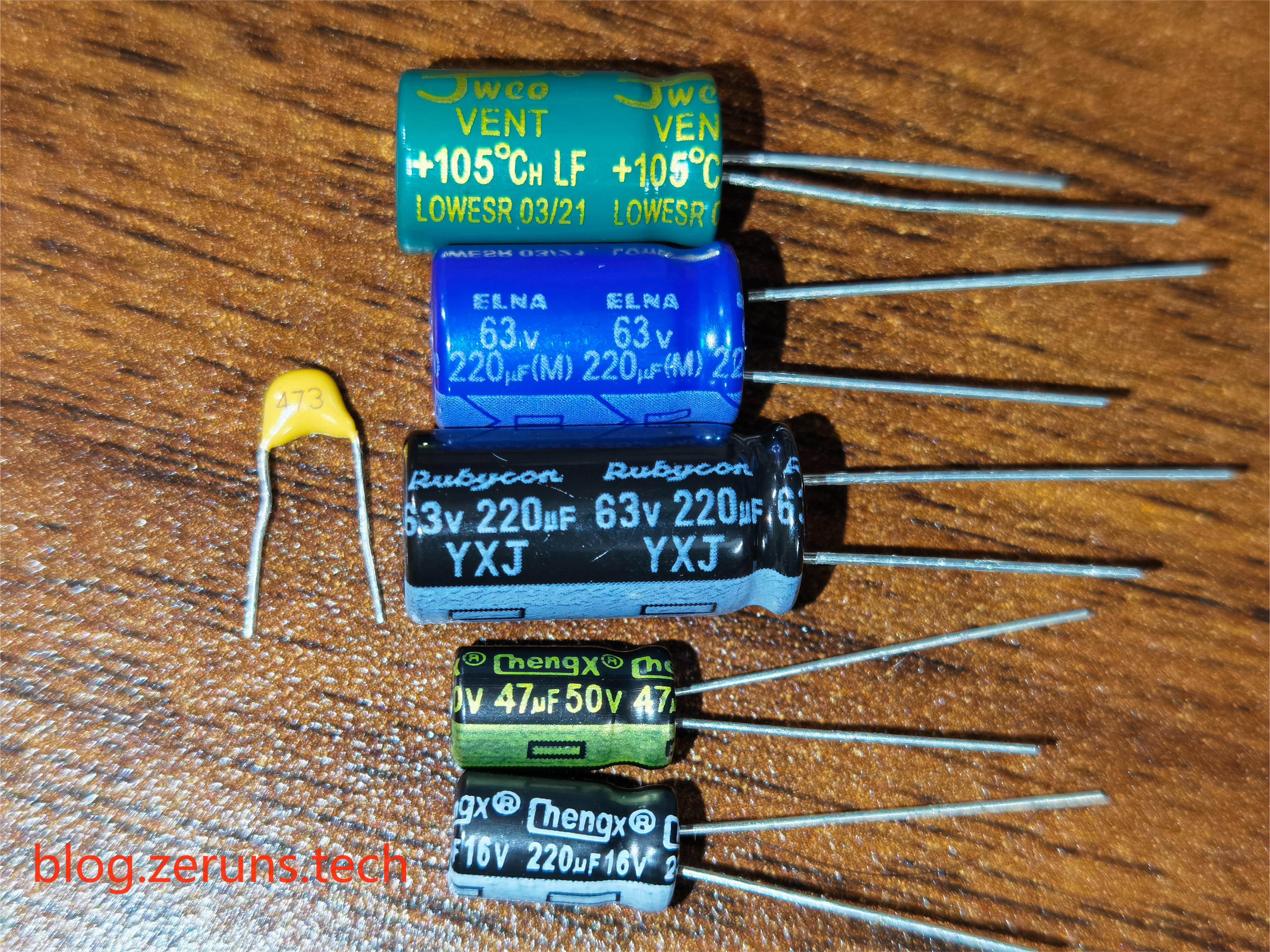
Some of the tested capacitors are shown below:
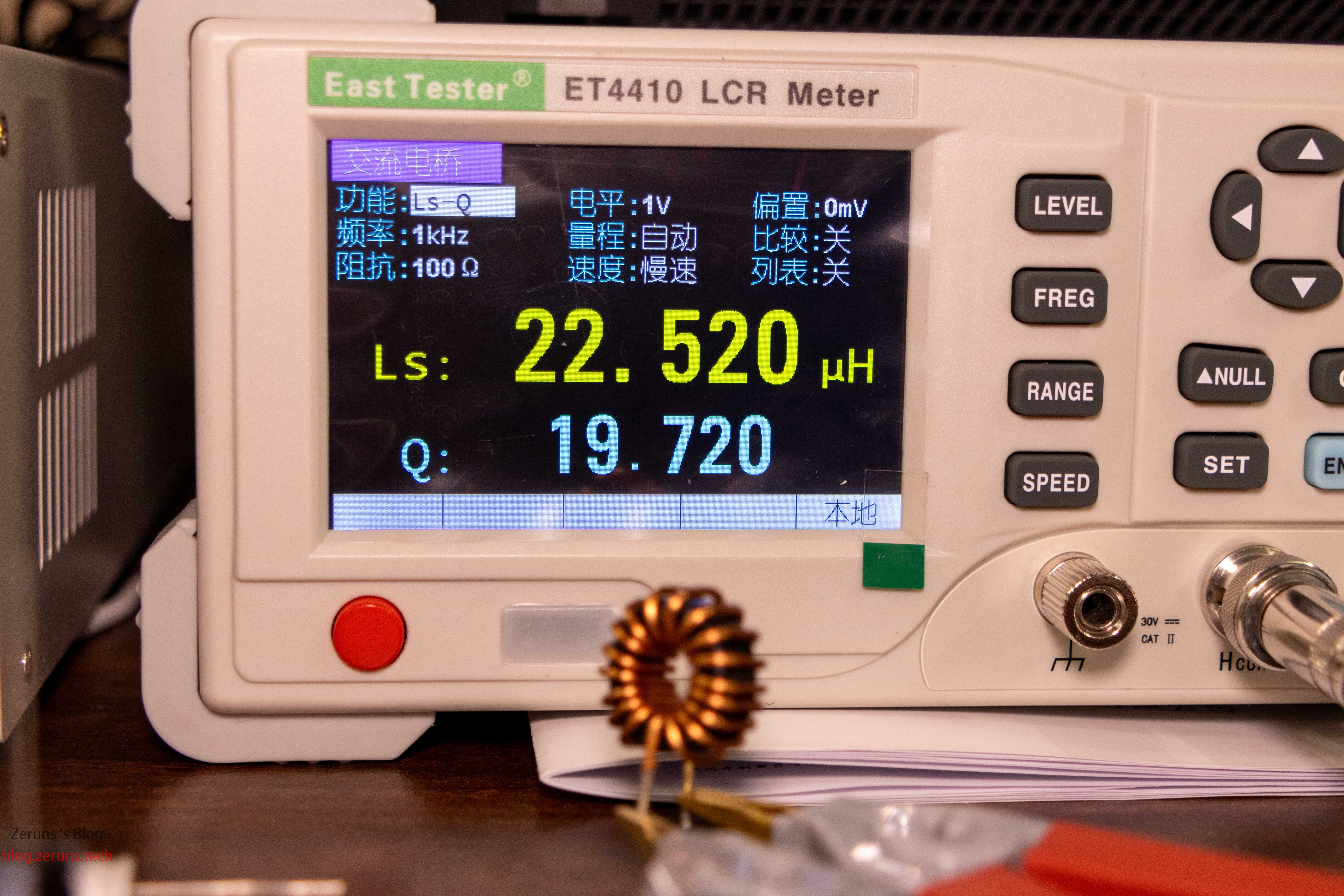
Inductors
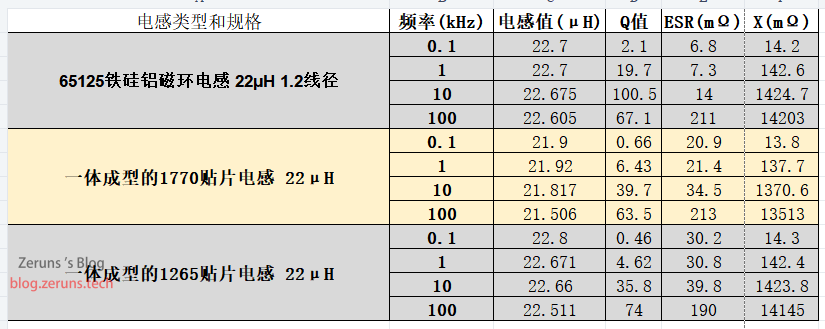
In the table below, “frequency” refers to the test frequency set on the bridge. Each component was measured at four frequency points—100 Hz, 1 kHz, 10 kHz, and 100 kHz—with a fixed test level of 1 V.
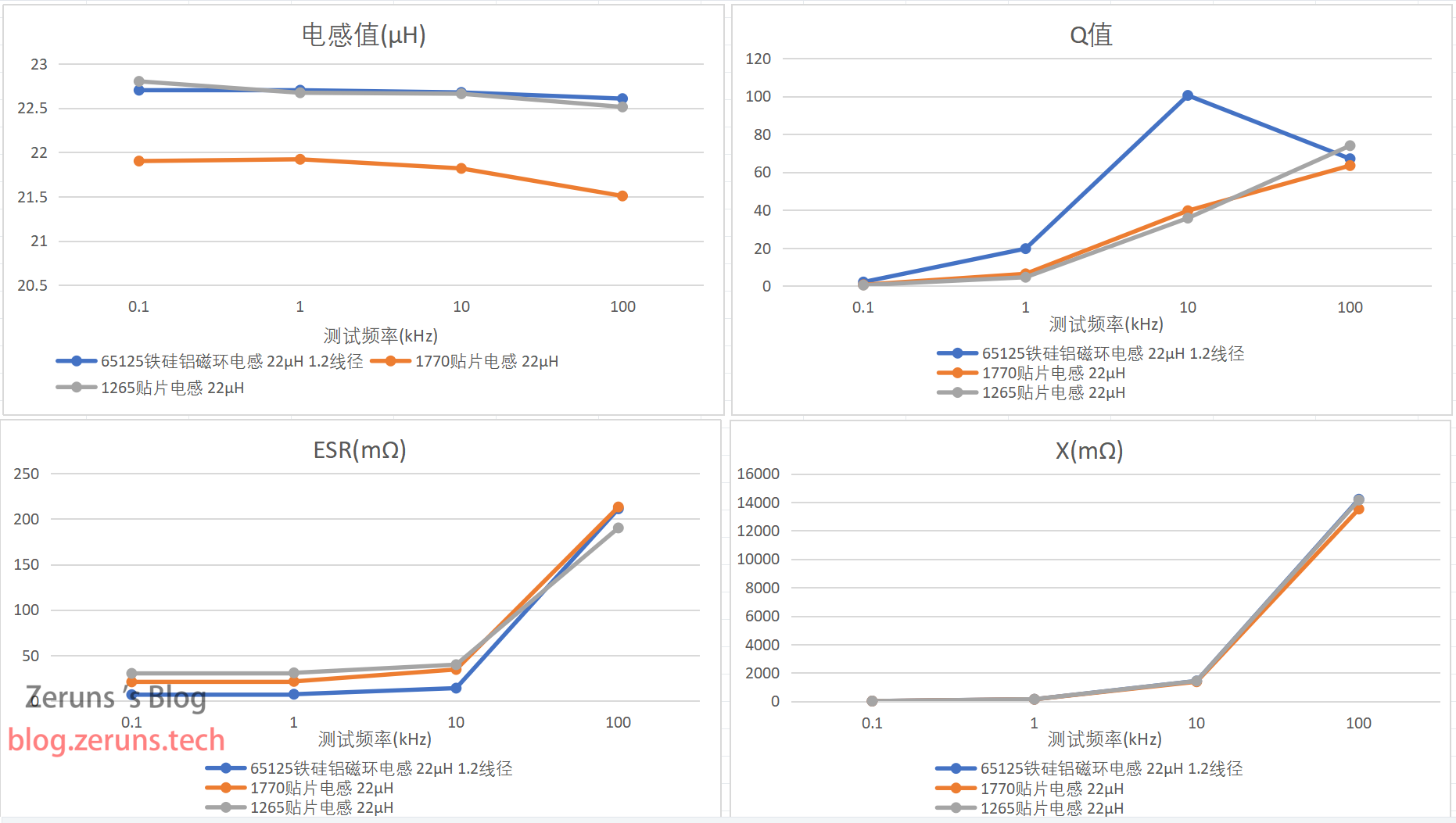
Generally, a higher Q is better, while lower ESR and X are preferable.
| Inductor Type & Spec | Freq (kHz) | L (μH) | Q | ESR (mΩ) | X (mΩ) |
|---|---|---|---|---|---|
| 65125 Sendust Core, 22 µH, 1.2 mm wire | 0.1 | 22.7 | 2.1 | 6.8 | 14.2 |
| 65125 Sendust Core, 22 µH, 1.2 mm wire | 1 | 22.7 | 19.7 | 7.3 | 142.6 |
| 65125 Sendust Core, 22 µH, 1.2 mm wire | 10 | 22.675 | 100.5 | 14 | 1424.7 |
| 65125 Sendust Core, 22 µH, 1.2 mm wire | 100 | 22.605 | 67.1 | 211 | 14203 |
| 1770 Molded SMD Inductor, 22 µH | 0.1 | 21.9 | 0.66 | 20.9 | 13.8 |
| 1770 Molded SMD Inductor, 22 µH | 1 | 21.92 | 6.43 | 21.4 | 137.7 |
| 1770 Molded SMD Inductor, 22 µH | 10 | 21.817 | 39.7 | 34.5 | 1370.6 |
| 1770 Molded SMD Inductor, 22 µH | 100 | 21.506 | 63.5 | 213 | 13513 |
| 1265 Molded SMD Inductor, 22 µH | 0.1 | 22.8 | 0.46 | 30.2 | 14.3 |
| 1265 Molded SMD Inductor, 22 µH | 1 | 22.671 | 4.62 | 30.8 | 142.4 |
| 1265 Molded SMD Inductor, 22 µH | 10 | 22.66 | 35.8 | 39.8 | 1423.8 |
| 1265 Molded SMD Inductor, 22 µH | 100 | 22.511 | 74 | 190 | 14145 |
Summary:
- The sendust toroid doesn’t seem to perform well at high frequencies; Q drops at 100 kHz, peaking around 10 kHz (I also tried 20 kHz and it was even higher, so the peak is somewhere between 20 kHz and 100 kHz before declining).
- Molded SMD inductors have better high-frequency behavior: Q keeps rising with frequency and surpasses the toroid at 100 kHz.
- The toroid has lower ESR, probably due to its thicker wire, but its ESR becomes higher than the molded parts at elevated frequencies.
Capacitors
Again, each part was measured at 100 Hz, 1 kHz, 10 kHz, and 100 kHz with 1 V test level.
Lower D, ESR, and X are generally desired.
The Rubycon and ELNA caps were bought from a small Taobao shop and are likely counterfeit.
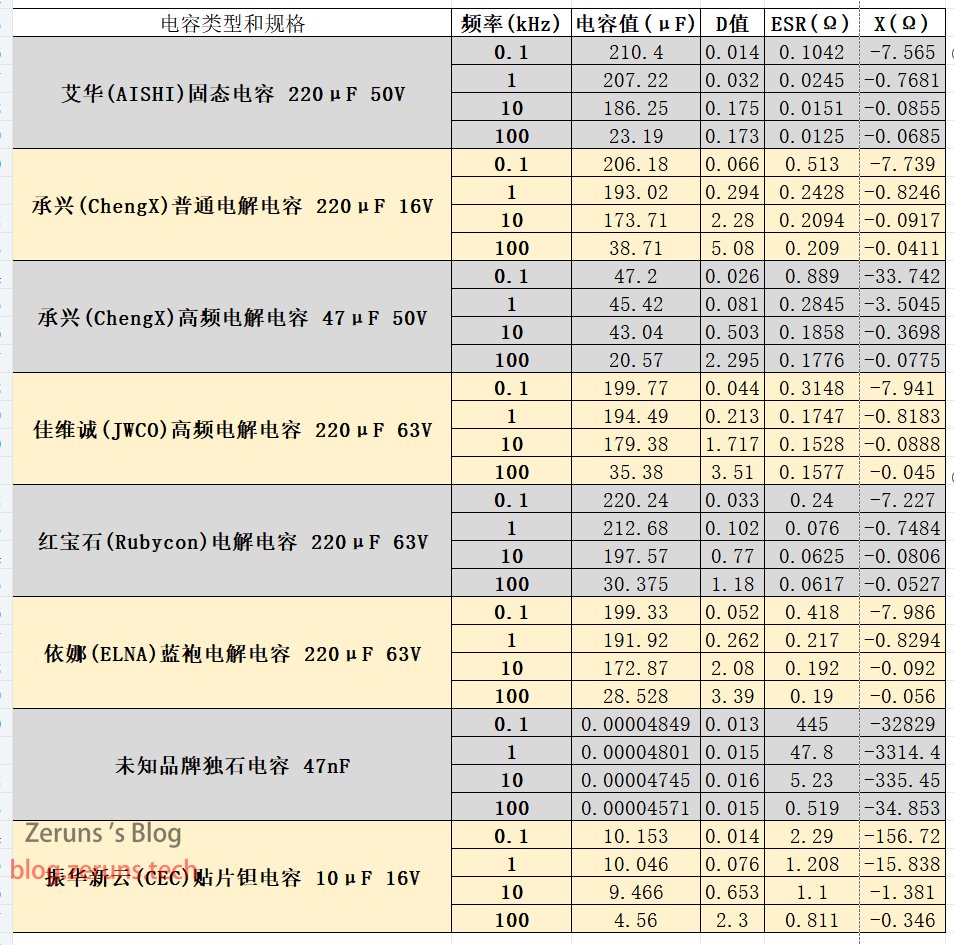
| Cap Type & Spec | Freq (kHz) | C (µF) | D | ESR (Ω) | X (Ω) |
|---|---|---|---|---|---|
| AISHI Polymer Solid, 220 µF, 50 V | 0.1 | 210.4 | 0.0138 | 0.1042 | -7.565 |
| AISHI Polymer Solid, 220 µF, 50 V | 1 | 207.22 | 0.0318 | 0.0245 | -0.7681 |
| AISHI Polymer Solid, 220 µF, 50 V | 10 | 186.25 | 0.175 | 0.0151 | -0.0855 |
| AISHI Polymer Solid, 220 µF, 50 V | 100 | 23.19 | 0.173 | 0.0125 | -0.0685 |
| ChengX General Al-Elec, 220 µF, 16 V | 0.1 | 206.18 | 0.0662 | 0.513 | -7.739 |
| ChengX General Al-Elec, 220 µF, 16 V | 1 | 193.02 | 0.2939 | 0.2428 | -0.8246 |
| ChengX General Al-Elec, 220 µF, 16 V | 10 | 173.71 | 2.28 | 0.2094 | -0.0917 |
| ChengX General Al-Elec, 220 µF, 16 V | 100 | 38.71 | 5.08 | 0.209 | -0.0411 |
| ChengX HF Al-Elec, 47 µF, 50 V | 0.1 | 47.2 | 0.0264 | 0.889 | -33.742 |
| ChengX HF Al-Elec, 47 µF, 50 V | 1 | 45.42 | 0.0811 | 0.2845 | -3.5045 |
| ChengX HF Al-Elec, 47 µF, 50 V | 10 | 43.04 | 0.503 | 0.1858 | -0.3698 |
| ChengX HF Al-Elec, 47 µF, 50 V | 100 | 20.57 | 2.295 | 0.1776 | -0.0775 |
| JWCO HF Al-Elec, 220 µF, 63 V | 0.1 | 199.77 | 0.0437 | 0.3148 | -7.941 |
| JWCO HF Al-Elec, 220 µF, 63 V | 1 | 194.49 | 0.2133 | 0.1747 | -0.8183 |
| JWCO HF Al-Elec, 220 µF, 63 V | 10 | 179.38 | 1.717 | 0.1528 | -0.0888 |
| JWCO HF Al-Elec, 220 µF, 63 V | 100 | 35.38 | 3.51 | 0.1577 | -0.045 |
| Rubycon Al-Elec, 220 µF, 63 V | 0.1 | 220.24 | 0.0332 | 0.24 | -7.227 |
| Rubycon Al-Elec, 220 µF, 63 V | 1 | 212.68 | 0.1018 | 0.076 | -0.7484 |
| Rubycon Al-Elec, 220 µF, 63 V | 10 | 197.57 | 0.77 | 0.0625 | -0.0806 |
| Rubycon Al-Elec, 220 µF, 63 V | 100 | 30.375 | 1.18 | 0.0617 | -0.0527 |
| ELNA Cerafine Al-Elec, 220 µF, 63 V | 0.1 | 199.33 | 0.0523 | 0.418 | -7.986 |
| ELNA Cerafine Al-Elec, 220 µF, 63 V | 1 | 191.92 | 0.262 | 0.217 | -0.8294 |
| ELNA Cerafine Al-Elec, 220 µF, 63 V | 10 | 172.87 | 2.08 | 0.192 | -0.092 |
| ELNA Cerafine Al-Elec, 220 µF, 63 V | 100 | 28.528 | 3.39 | 0.19 | -0.056 |
| Unknown Monolithic, 47 nF | 0.1 | 0.00004849 | 0.0134 | 445 | -32829 |
| Unknown Monolithic, 47 nF | 1 | 0.00004801 | 0.0145 | 47.8 | -3314.4 |
| Unknown Monolithic, 47 nF | 10 | 0.00004745 | 0.0155 | 5.23 | -335.45 |
| Unknown Monolithic, 47 nF | 100 | 0.00004571 | 0.0151 | 0.519 | -34.853 |
| CEC SMD Tantalum, 10 µF, 16 V | 0.1 | 10.153 | 0.0143 | 2.29 | -156.72 |
| CEC SMD Tantalum, 10 µF, 16 V | 1 | 10.046 | 0.0763 | 1.208 | -15.838 |
| CEC SMD Tantalum, 10 µF, 16 V | 10 | 9.466 | 0.653 | 1.1 | -1.381 |
| CEC SMD Tantalum, 10 µF, 16 V | 100 | 4.56 | 2.3 | 0.811 | -0.346 |
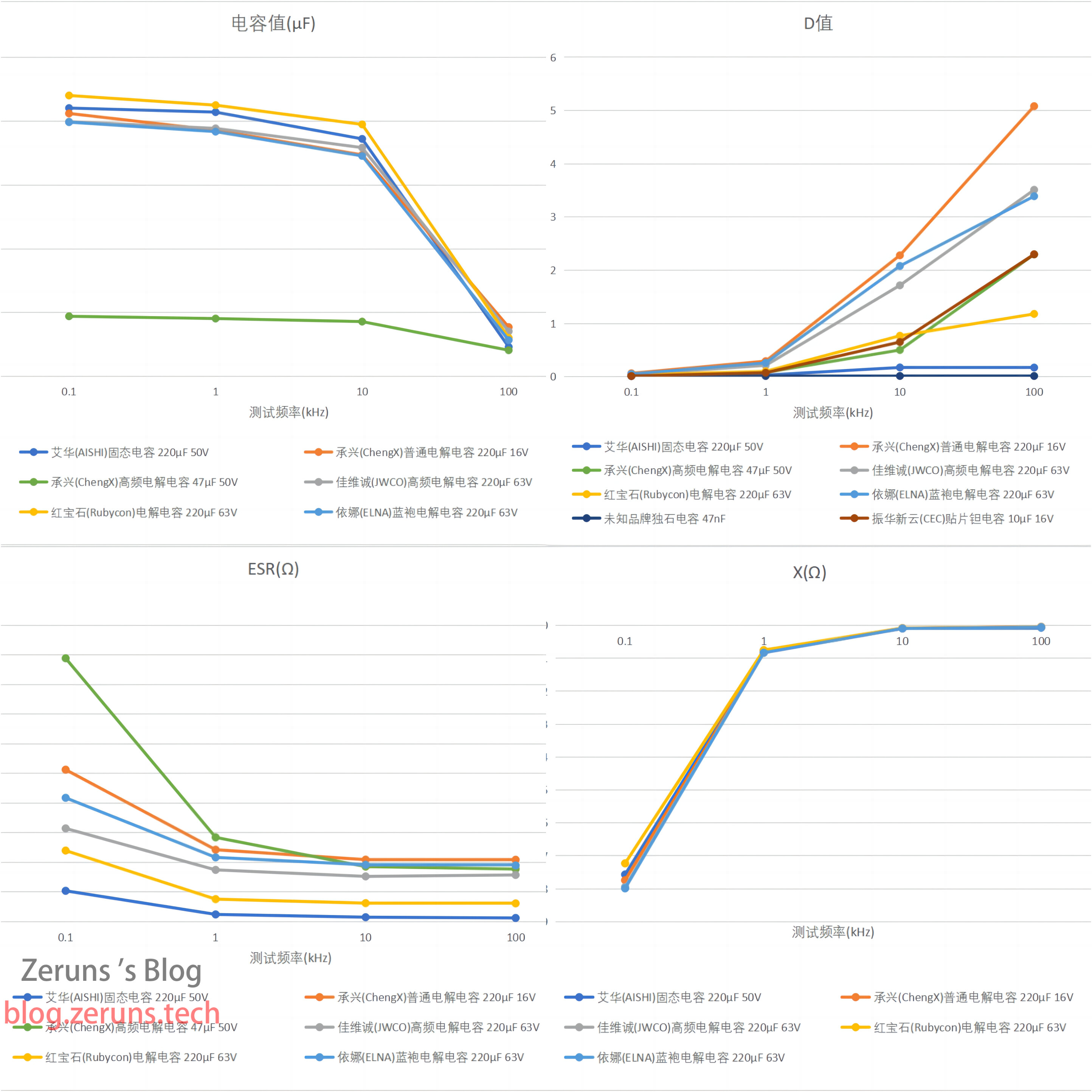
Summary:
- Solid and electrolytic capacitors show obvious capacitance drop above 10 kHz.
- Monolithic caps exhibit very high reactance and ESR at low frequencies.
- Electrolytics see a large increase in D at higher frequencies, whereas solids hardly change; overall performance of solids is much better.
- Performance varies noticeably among electrolytic brands; Rubycon tested best here.
- Capacitive reactance decreases as frequency increases.
Conclusions may not be perfectly accurate—use as reference only.
Recommended Reading
- Cost-effective & Cheap VPS / Cloud Servers: https://blog.zeruns.com/archives/383.html
- Build a Typecho Personal Blog on a Cloud Server, Step-by-Step Guide: https://blog.zeruns.com/archives/749.html
- Minecraft Server Setup Tutorial: https://blog.zeruns.com/tag/mc/
- Palworld Server Setup Tutorial: https://blog.zeruns.com/tag/PalWorld/
- Riden RD6012P CNC Bench Power Supply Brief Review, 60 V 12 A: https://blog.zeruns.com/archives/740.html
- Bambu Lab A1 Combo 3D Printer Unboxing Experience: https://blog.zeruns.com/archives/754.html