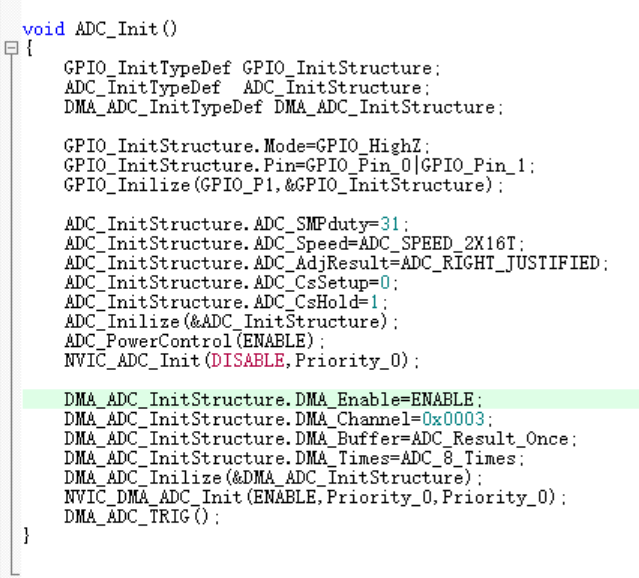
佬们好,stc8a8k64d4,用的stc官方库函数,设置好了dma_adc转运,我判断dmaadcflag是否置1发送串口消息,但是一直发不出去(我很确定是dmaadcflag没有置1的问题,因为没了这个判断串口发送是正常的),然后我跟官方例程也对了很久,没看出来有啥问题。如图所示,然后我dma转运到的是u16的十六个元素的数组。查了三个小时没查出来啥问题,我就是个苦学生,求求了。
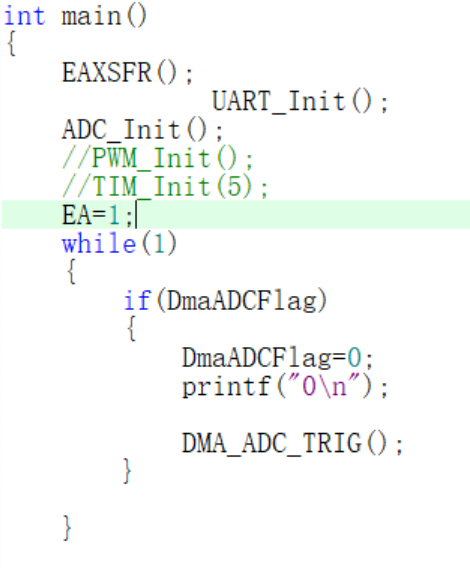
Focus on checking the interrupt! I see you’ve enabled NVIC_DMA_ADC_Init, but did you write the corresponding interrupt service function? The interrupt function names for STC are fixed—you can’t just make them up. If the name is wrong, the interrupt won’t be triggered at all, and the flag bit naturally won’t be set to 1. Also, don’t mix up the interrupt numbers with others.
This is a very typical beginner pitfall in DMA-ADC development for the STC8A8K64D4. I’ll break down the issues and solutions for you in descending order of priority—follow this checklist step by step, and you’ll resolve the problem.
1. Core Issues (90% chance your problem lies here)
1. Must enable ADC’s DMA function—otherwise, ADC won’t trigger DMA transfer
Your ADC initialization code completely lacks enabling the ADC’s DMA feature! For the STC8A series, when using ADC with DMA, the ADC must be configured to automatically trigger a DMA transfer upon conversion completion. Without enabling this, even if ADC conversions finish, DMA will not start—hence no transfer-complete interrupt will fire, and the flag will never be set.
- Fix: Add DMA enable configuration in your ADC initialization structure:
ADC_InitStructure.ADC_DMA_Enable = ENABLE; // Critical: Enable ADC-triggered DMA
- If your library doesn’t have this field, manually set the register:
ADC_CONTR |= 0x40; // Set the ADC_DMA_EN bit (refer to your chip manual for exact bit position)
2. Incorrect DMA initialization—missing destination buffer address
In your code, DMA_ADC_InitStructure.DMA_Buffer = ADC_Result_Once; is completely wrong:
-
ADC_Result_Onceis a transfer mode macro (single transfer), not a buffer address. -
You did not assign the actual address of your defined u16 array. As a result, DMA doesn’t know where to store the ADC results, so transfers cannot complete properly.
-
Correct DMA initialization example (based on STC official standard library):
u16 AdcResultBuf[16]; // Your 16-element u16 array
DMA_ADC_InitStructure.DMA_Enable = ENABLE;
DMA_ADC_InitStructure.DMA_Channel = 0x0003; // ADC uses DMA channel 3 — your setting was correct
DMA_ADC_InitStructure.DMA_Mode = ADC_Result_Once; // Transfer mode goes here
DMA_ADC_InitStructure.DMA_Times = 16; // Number of transfers must match array length — 8 is incorrect
DMA_ADC_InitStructure.DMA_AdcResult = AdcResultBuf; // Critical: Assign the actual buffer address
3. Flag variable must be volatile, and must be set inside the ISR
You didn’t show your interrupt function or flag definition—this is one of the most commonly missed points:
-
Problem 1: If
DmaADCFlagis modified in an interrupt and checked inmain, it must be declared asvolatile. Otherwise, the compiler may optimize away the check inmain, assuming the variable never changes—even after the interrupt sets it to 1. -
Problem 2: You must implement the correct DMA-ADC interrupt service routine (ISR) and set the flag inside it. Without this, the flag remains 0 forever.
-
Correct implementation:
volatile u8 DmaADCFlag = 0; // Must use 'volatile'!!!

// Interrupt service routine — 'interrupt' number must match library definition (usually INT_NO_DMA_ADC = 22)
void DMA_ADC_Isr(void) interrupt INT_NO_DMA_ADC
{
    DmaADCFlag = 1; // Set flag upon transfer completion
}
2. Secondary but Essential Fixes
1. Mismatch between DMA transfer count and array size
You mentioned having a 16-element u16 array, but your code uses DMA_Times = ADC_8_Times (i.e., 8 transfers). This mismatch means only half the data will be transferred, and subsequent logic will fail. Always ensure the transfer count matches the buffer size.
Fix: Set
DMA_Times = 16.
2. ADC conversion mode must align with DMA triggering
Your ADC is likely left in default single-conversion mode. After one DMA transfer completes, unless ADC is restarted, no further conversions occur—and thus no further DMA triggers happen.
- Recommended solution: Switch to continuous conversion mode:
ADC_InitStructure.ADC_Conversion = ADC_CONVERSION_CONTINUOUS; // Enable continuous conversion
- Alternatively, manually restart ADC after each DMA trigger:
DMA_ADC_TRIG();
ADC_START(); // Use the appropriate ADC start macro from your library
3. Recommended Debugging Sequence
- Add
volatileto your flag and write the correct ISR—verify that the interrupt actually executes. - Fix ADC initialization by enabling ADC-to-DMA triggering (
ADC_DMA_Enable). - Correct DMA setup: Ensure transfer mode, count, and buffer address are all properly assigned.
- Verify global interrupt enable (
EA = 1) and DMA interrupt enable are both set. - Simplify testing first: Reduce transfer count to 1 and use a 1-element array. Get single transfer working before scaling back to 16 transfers.