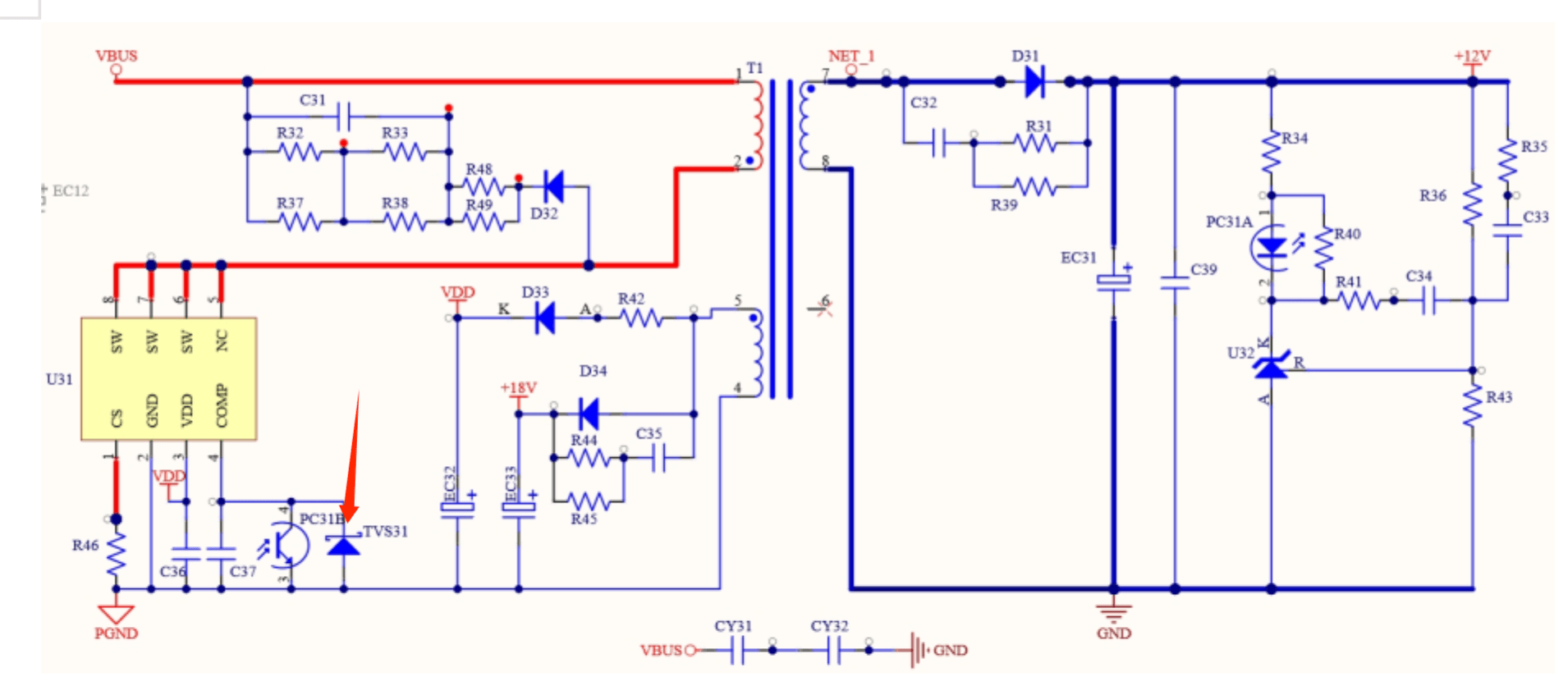
I’d like to ask the experts here. In this flyback power supply, what is the purpose of TVS31 connected to the COMP pin? I asked AI, and it said it’s used for voltage clamping to protect the COMP pin, but my supervisor said that’s not its function and told me to look it up myself. I really can’t find any other purpose.
I would check the actual voltage rating of TVS31 before making any conclusion.
If the TVS breakdown voltage is much higher than the normal COMP operating voltage, then yes, it is mainly a protection clamp.
But if the clamp voltage is close to the COMP operating range, it may be intentionally used to limit the maximum COMP voltage and control the converter behavior during faults.
In flyback controllers, COMP is not just an input pin. It is usually the output of the error amplifier and directly affects the PWM modulator. A saturated COMP signal can cause unwanted maximum duty-cycle operation.
So your professor may be saying that “protecting COMP pin” is not the real design intention. The real purpose is protecting the power supply control loop.
Look at it from another angle: what exactly is COMP in a flyback power supply?
It is the output of the internal error amplifier, and it directly determines the threshold of the PWM comparator—the higher the COMP voltage, the greater the duty cycle. And this error amplifier is essentially an integrator.
At startup, the output voltage is zero, and the secondary-side feedback has not yet been established, so the integrator keeps accumulating charge and the COMP voltage rises. Without an upper limit, the duty cycle would go to its maximum; by the time the feedback finally responds, the output voltage has already overshot severely.
The TVS adds a nonlinear ceiling to this integrator. When COMP reaches the breakdown voltage (for example, 5 V or 6 V), the TVS conducts and “clamps” COMP, so the duty cycle is effectively limited. This is a very inexpensive soft-start aid.
Another scenario: if the optocoupler has a cold solder joint, the TL431 is damaged, or an output short circuit breaks the feedback path, COMP will be pulled up to VDD. The presence of the TVS keeps COMP at a controllable saturation voltage, allowing the controller’s internal timeout protection circuit to detect a “loop fault” and then enter hiccup mode.
So when your mentor told you “it’s not for protecting the COMP pin,” what they meant is that its design intent is to control system behavior (limit duty cycle, suppress overshoot, preserve fault mode), not to protect that IC from electrostatic damage.