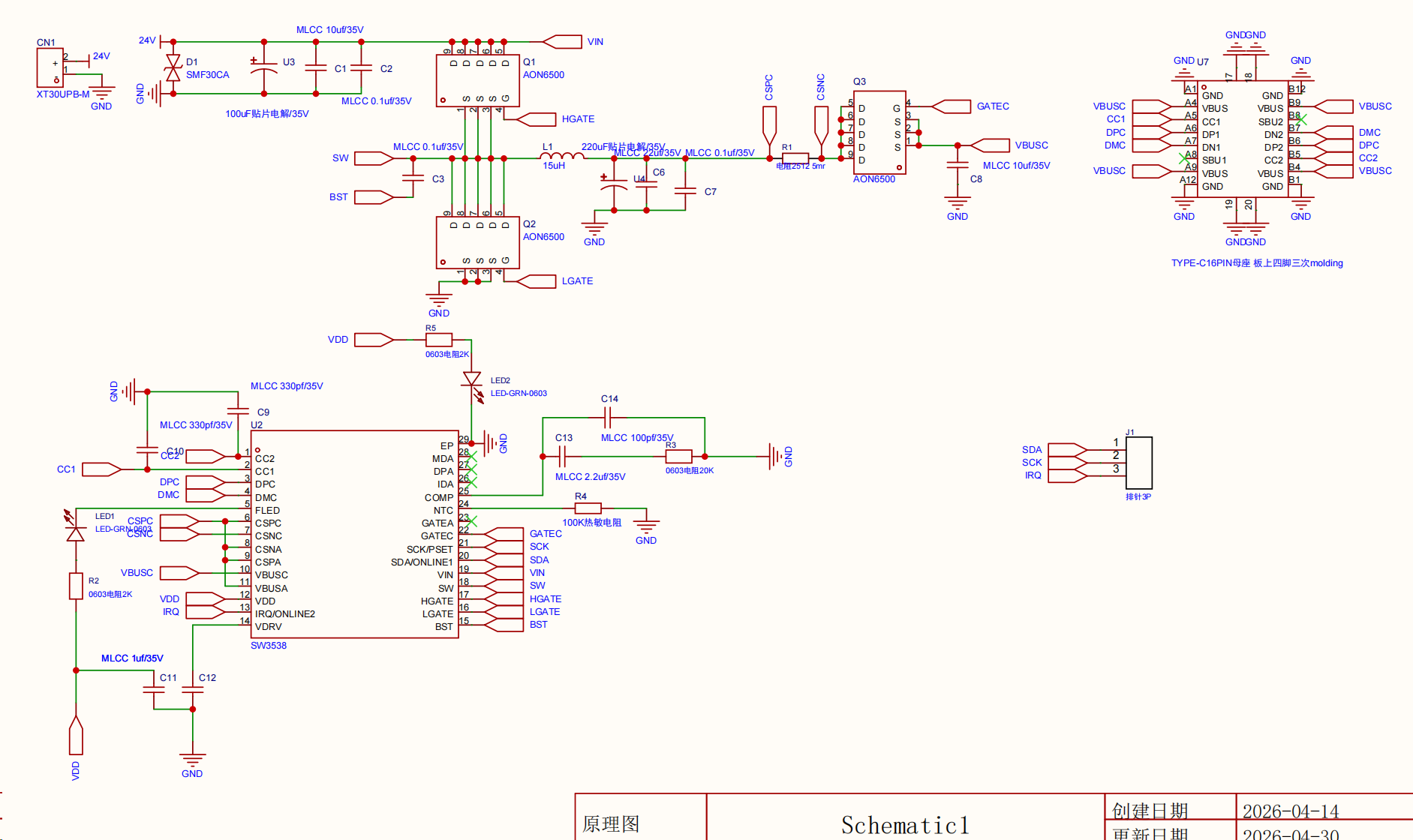
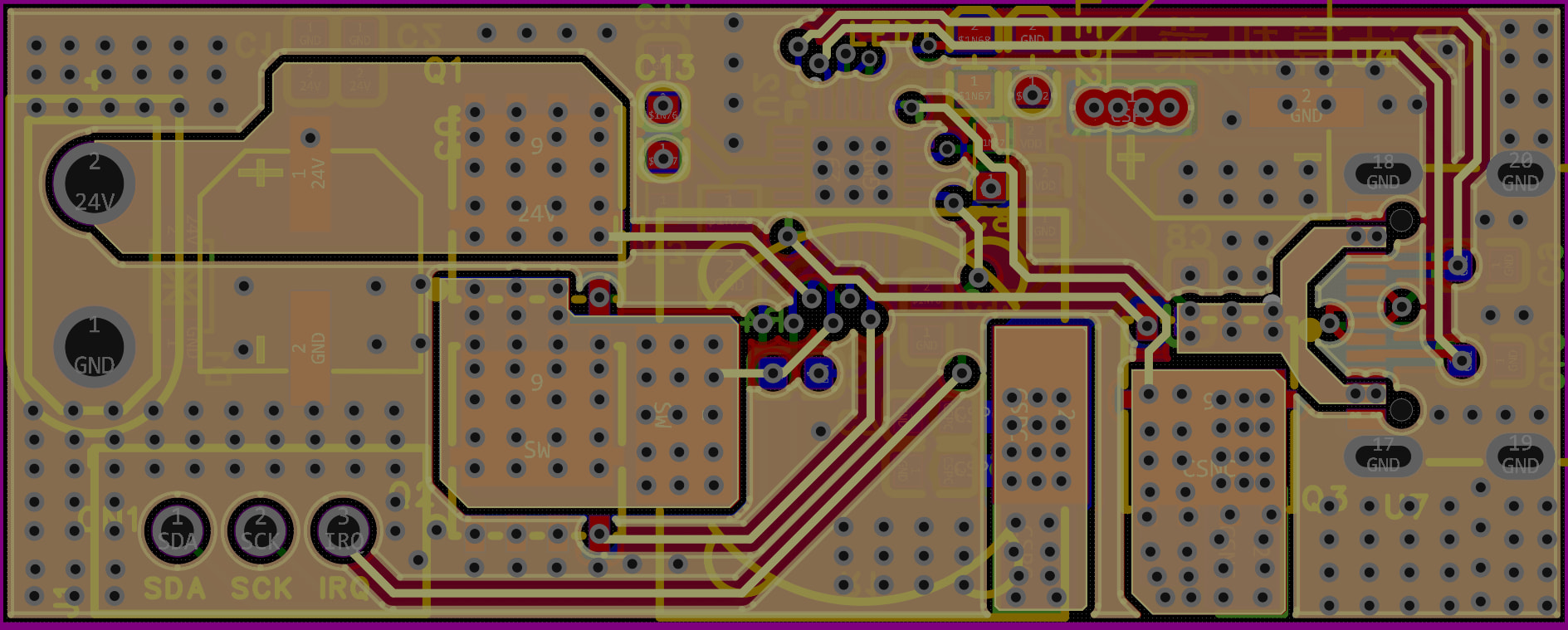
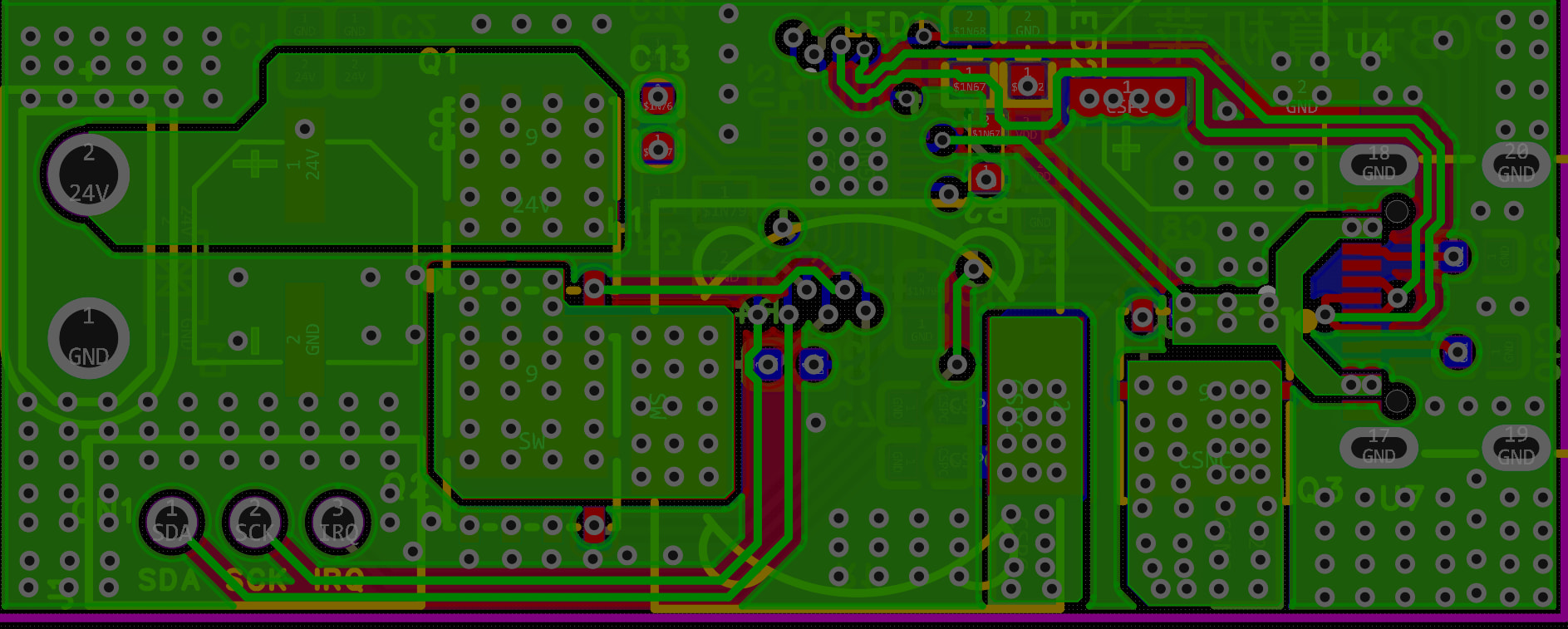
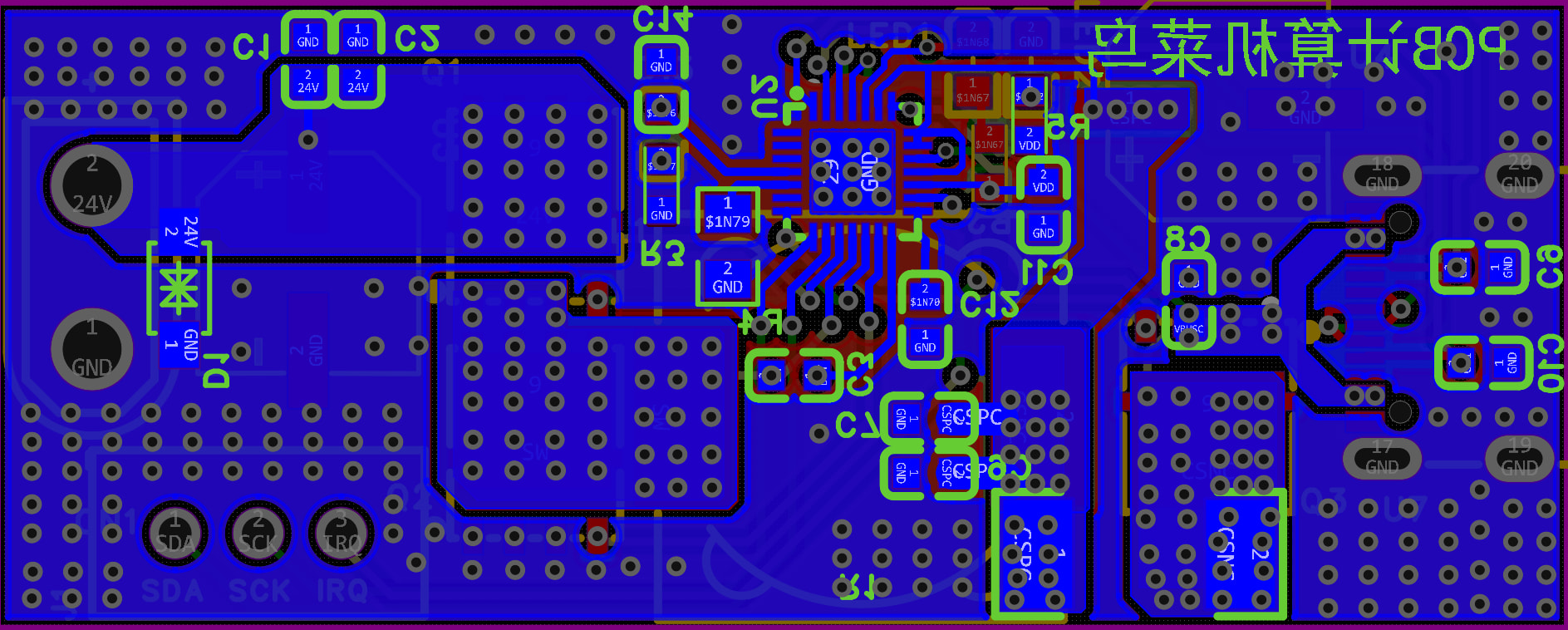
Hey guys, I built a single-port Type-C fast charging module based on the SW3538 chip. The VDD pin works fine after powering on, but plugged-in devices aren't recognized and it won't charge.

After powering on the module now, the LED in series with the chip’s VDD pin lights up normally, but when a phone or other electronic device is plugged in, it is not recognized and cannot charge. Measuring the chip’s SW pin with an oscilloscope also shows no frequency

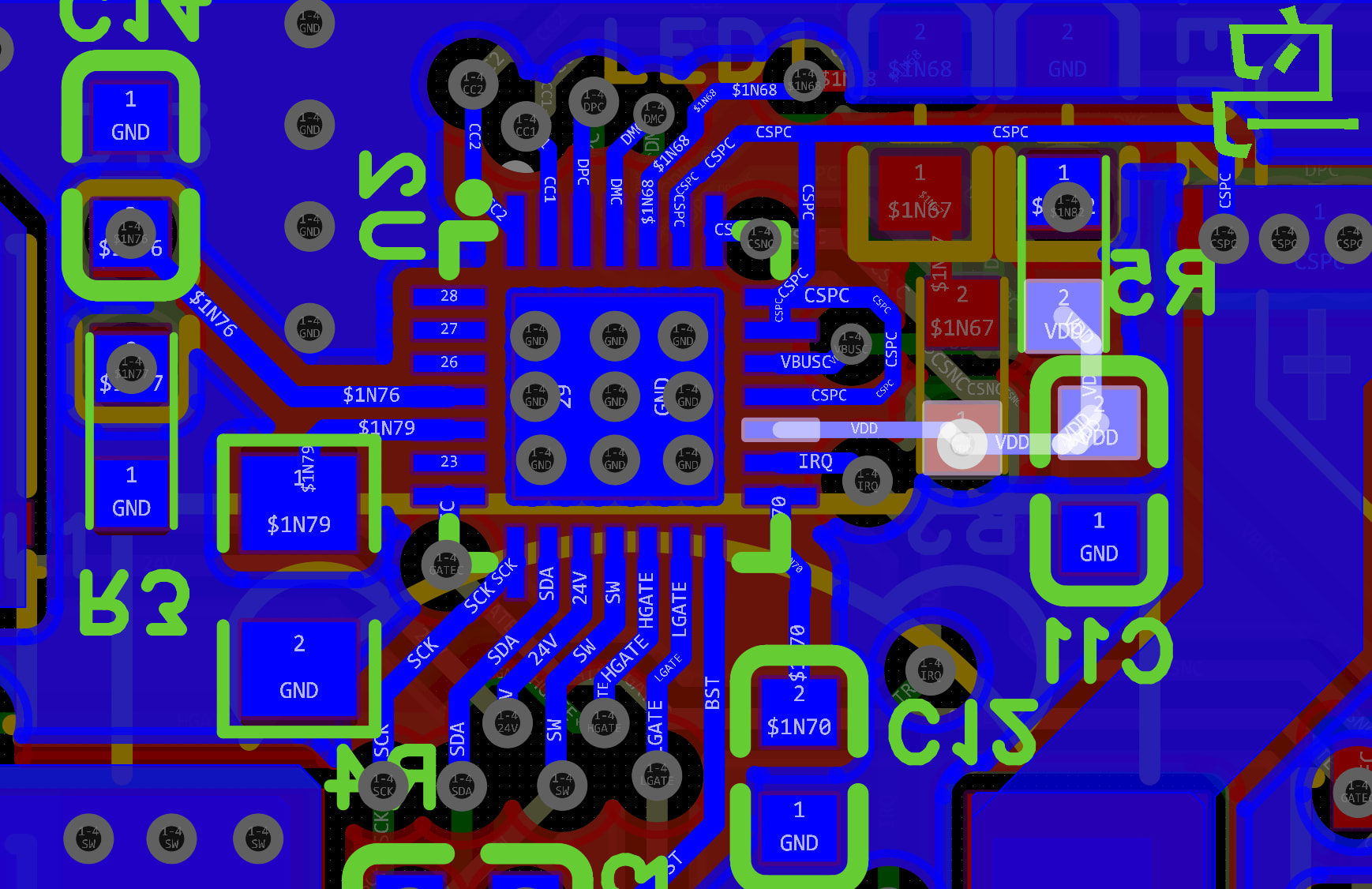
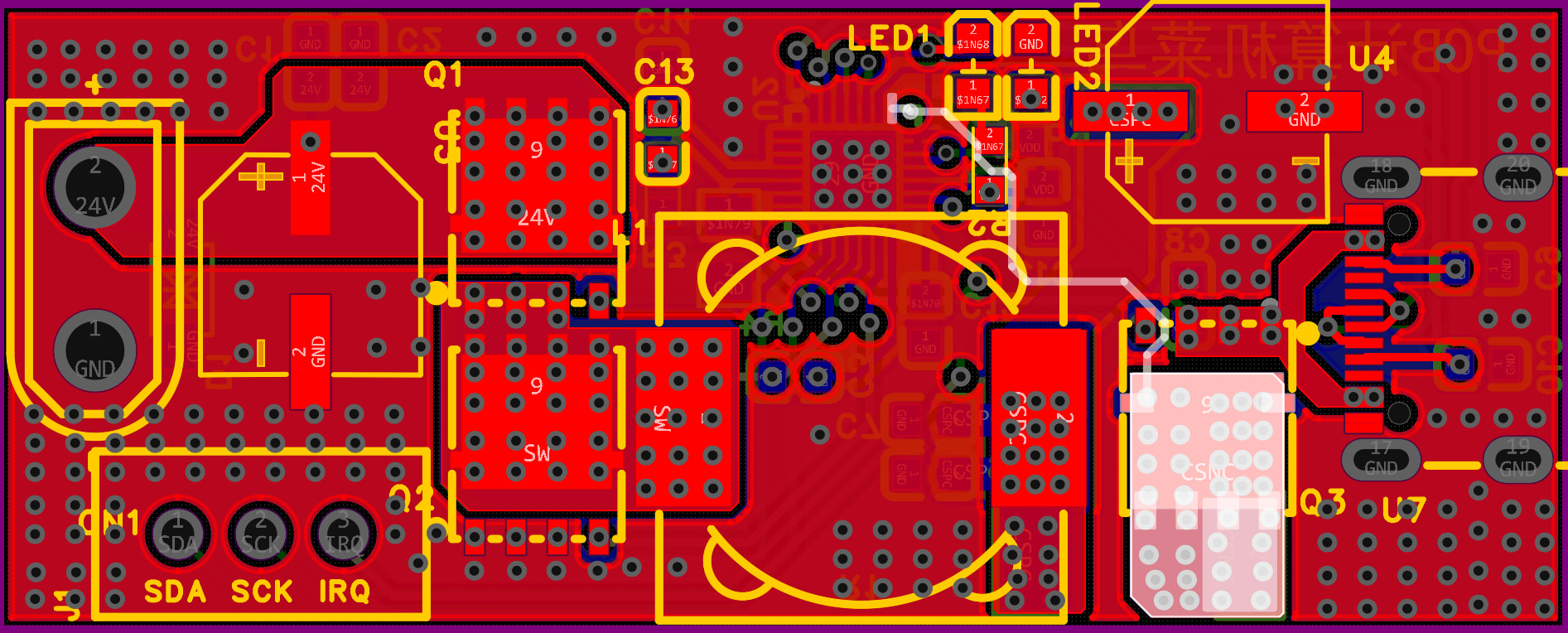
Take a look at the picture of the circuit you soldered, and the close-up, to see if there are any cold solder joints on the QFN chip.

I suggest doing an „amputation“ check first:

  1. Disconnect the Q3 power MOSFET at the output, and see if the chip’s GATEA/GATEB has drive pulses.
  2. Your BST capacitor (C3) is a bit far from the chip, and the trace is too thin. The loop area of the bootstrap capacitor must be kept as small as possible; otherwise, the drive current will be insufficient, the high-side switch won’t turn on, and there will be no output at SW.
  3. Check if the CC pin is shorted to ground. If you’re using a Type-C connector with a grounded shell, it’s very easy to short the signal pins to the shell during soldering.

Why are CSPC, CSPA, CSNA, and VBUSA shorted together on your circuit?

Check if the NTC thermistor resistance is correct. Using the wrong thermistor can result in an incorrect resistance, which might trigger overheat protection.

I see a lot of vias on your power path, but what about the Ground Return? The loop from the output caps back to the input caps needs to be as short as possible. One specific thing: Check your NTC resistor (R4). If the voltage on Pin 24 isn’t exactly what the chip expects, it will stay in Thermal Shutdown. Since your VDD LED is on, the LDO is fine, so it’s definitely a logic-level “Inhibit” signal. Desolder the NTC and use a fixed resistor to rule out temperature protection issues.

I previously made my board referencing this open-source design, and I see their wiring is done like this https://oshwhub.com/wffg/sw3538_1

I referred to the datasheet and used a 10K NTC thermistor.

I see the one in your link uses a 10k NTC thermistor, and you just straight up changed it to 100k???

I’m using a 10K NTC resistor, and I see the wiring example in the datasheet also uses a 10K NTC resistor.

Your schematic is labeled 100K. Also, there are multiple types of thermistors—positive temperature coefficient, negative temperature coefficient—and they have different B-values.
If you’re not sure which thermistor you’re using, you can try swapping it with a standard 10k resistor.

Sorry, sorry boss, I dropped a zero in my reply. I went back and checked the datasheet and my Taobao purchase history, and I’m using a 100K resistor.

Alright boss, I’ll try the board again.

Strange, I see the thermistor model used in the datasheet is 104AT. Below are the parameters for the 104AT that I asked an AI about:

104AT is not an ordinary fixed resistor, but a very common NTC (Negative Temperature Coefficient) thermistor. It was originally developed by Semitec (Ishizuka Electronics) of Japan and has now become an industry-standard model due to its high precision and high stability.

Below are the detailed parameters and specific information about the 104AT:

1. Breakdown of the Naming Convention

  • 104: Represents its nominal resistance at 25^\circ\text{C}. The first two digits are significant figures, and the third is the power of 10.

  • 10 \times 10^4 = 100,000 \Omega = \mathbf{100k\Omega}.

  • AT: Represents the product series number (AT series), whose main features are high precision and miniaturization.


2. Core Technical Parameters

Parameter Typical Value Description
Nominal Resistance (R_{25}) 100\text{k}\Omega \pm 1\% The resistance measured at an ambient temperature of 25^\circ\text{C}.
B-Value (B_{25/85}) 4039\text{K} \pm 1\% A constant reflecting the material’s sensitivity to temperature (determined by 25^\circ\text{C} and 85^\circ\text{C}).
Operating Temperature Range -50^\circ\text{C} to +110^\circ\text{C} Exceeding this range may result in decreased precision or physical damage.
Dissipation Constant \approx 2.0\text{mW/}^\circ\text{C} The power required to raise the resistor’s temperature by 1^\circ\text{C} due to self-heating.
Time Constant \approx 10 - 15 seconds The time required for the resistance to change by 63.2\% of the final temperature difference in still air.
Maximum Rated Power 10\text{mW} To avoid self-heating effects interfering with measurements, it is generally recommended to keep the actual power well below this value.

3. Main Features

  1. Negative Temperature Coefficient: As the temperature increases, the resistance drops rapidly. This characteristic makes it highly suitable as a temperature sensor.
  2. High Precision: The 104AT-2 series typically provides a resistance tolerance of \pm 1\%, meaning it does not require complex calibration in temperature control circuits.
  3. Strong Interchangeability: Because the B-value of 4039K has become an industry benchmark, 100k NTCs produced by many manufacturers are compatible with this parameter.

4. Common Application Scenarios

Because its 100\text{k}\Omega resistance results in minimal current loss at room temperature, it is commonly used in:

  • Smart Home: Temperature monitoring for air conditioners, refrigerators, and water heaters.
  • Battery Protection: Overheat monitoring for laptop and mobile phone battery packs (BMS).
  • Office Equipment: Temperature control for printer fusers.
  • Electronic Thermometers: High-precision ambient temperature measurement.

5. Usage Recommendations

When designing a circuit, a voltage divider circuit is typically used to convert the resistance change into a voltage change, which is then fed into the ADC pin of a microcontroller (MCU).

Tip: If you are calculating the temperature, be sure to use the Steinhart-Hart equation or look up the R-T table (Resistance-Temperature correspondence table) for this specific model. Because the characteristics of an NTC are non-linear, a simple linear proportion will result in massive measurement errors.

Are you working on a specific circuit design, or do you need a resistance lookup table for this resistor at specific temperatures?

Send me the purchase link for your thermistor so I can take a look.

Try swapping in standard 10k and 100k resistors.

[Taobao] https://e.tb.cn/h.R0k031eCoKkrkXf?tk=AcqP5qZE9FM CZ057 “NTC SMD Thermistor 0805 2.2K 4.7K 6.8K 10K 22K 33K 47K 50K 100K”
Click the link to open directly, or search on Taobao to open directly

Legend! Awesome! I swapped in a 100K resistor and the module works now!!! Thanks for the tip, legend!!!

There’s a problem with the NTC thermistor I chose.