The sine function and cosine function are the most fundamental and important trigonometric functions. They are widely used in describing periodic phenomena, waves, vibrations, rotations, and more. Below is a detailed introduction to the sine and cosine functions.
Sine Function
Definition
For an angle \theta , the sine function \sin(\theta) is defined as the y-coordinate of the point on the unit circle corresponding to that angle. The unit circle is a circle with radius 1 centered at the origin.
Expression
Properties
-
Periodicity: The sine function is periodic with period 2\pi :
\sin(\theta + 2k\pi) = \sin(\theta)
where k is any integer. -
Even/Odd Nature: The sine function is an odd function:
\sin(-\theta) = -\sin(\theta) -
Range: The range of the sine function is [-1, 1] .
-
Special Values:
\sin(0) = 0
\sin\left(\frac{\pi}{2}\right) = 1
\sin(\pi) = 0
\sin\left(\frac{3\pi}{2}\right) = -1
\sin(2\pi) = 0
Graph
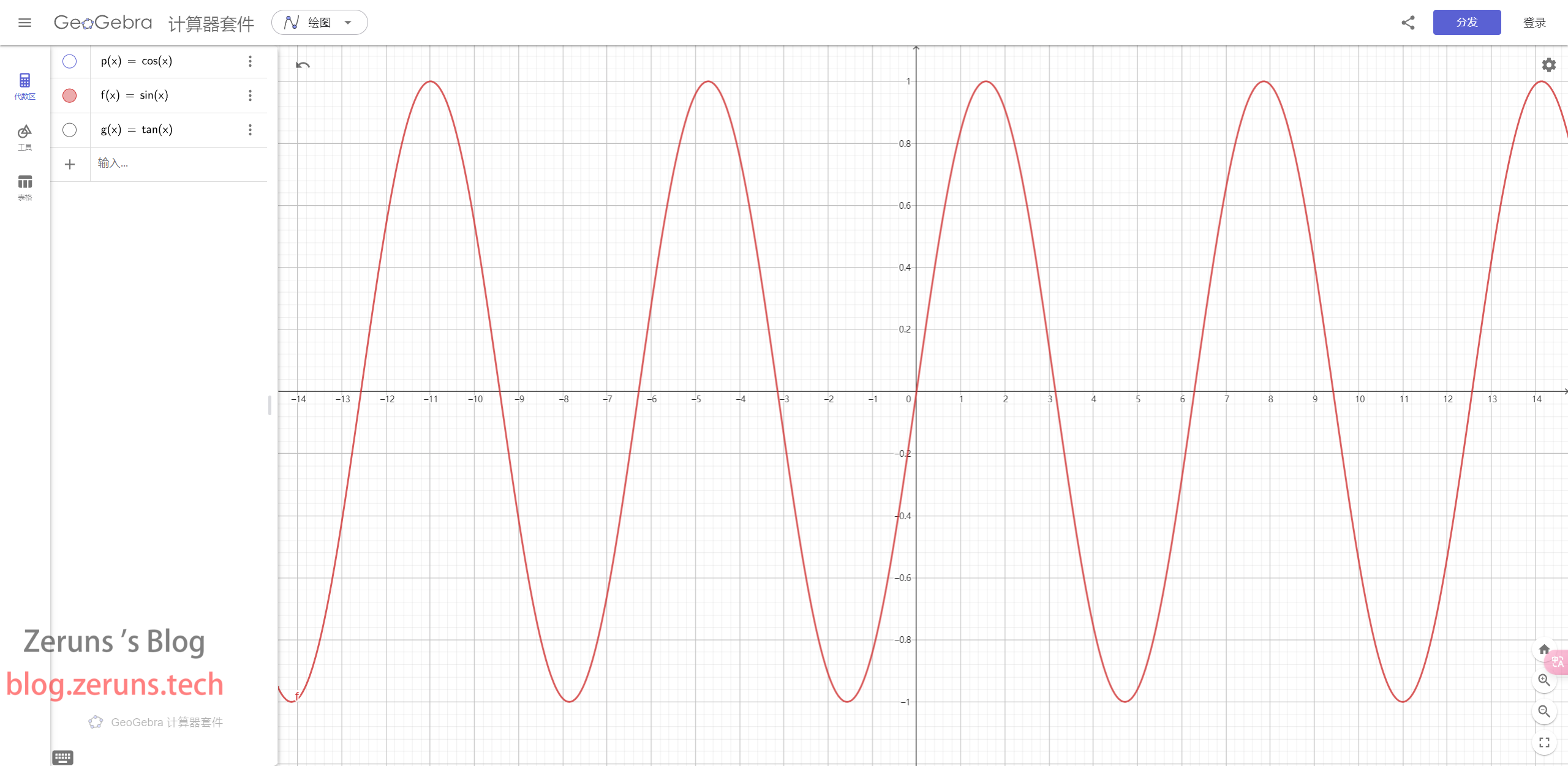
The graph of the sine function is a sinusoidal curve oscillating above and below the x-axis.
Cosine Function
Definition
For an angle \theta , the cosine function \cos(\theta) is defined as the x-coordinate of the point on the unit circle corresponding to that angle.
Expression
\cos(\theta) = \frac{\text{adjacent}}{\text{hypotenuse}}
Properties
-
Periodicity: The cosine function is periodic with period 2\pi :
\cos(\theta + 2k\pi) = \cos(\theta)
where k is any integer. -
Even/Odd Nature: The cosine function is an even function:
\cos(-\theta) = \cos(\theta) -
Range: The range of the cosine function is [-1, 1] .
-
Special Values:
\cos(0) = 1
\cos\left(\frac{\pi}{2}\right) = 0
\cos(\pi) = -1
\cos\left(\frac{3\pi}{2}\right) = 0
\cos(2\pi) = 1
Graph
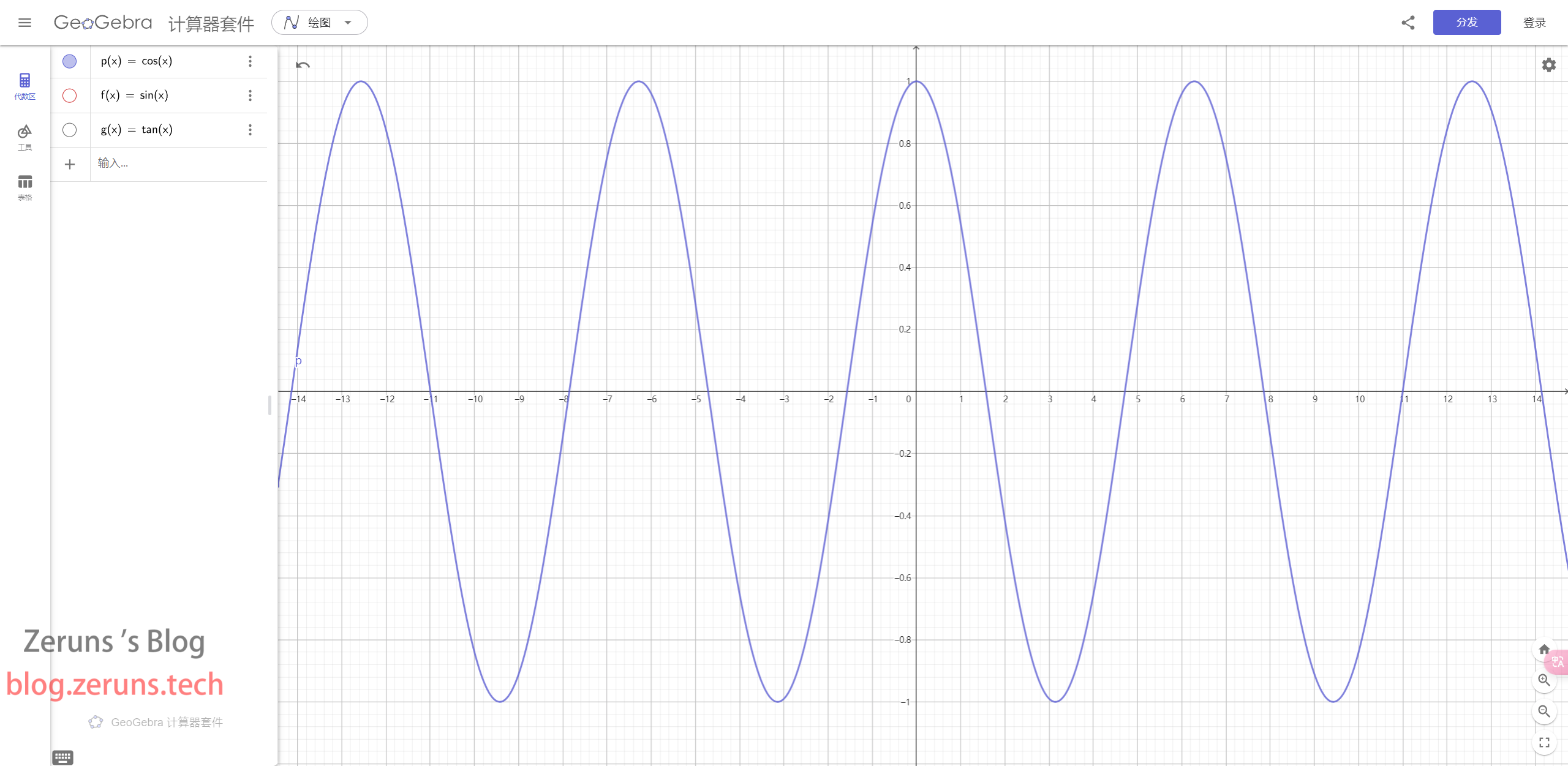
The graph of the cosine function is a wave symmetric about the y-axis, similar to the sine curve but phase-shifted.
Relationship Between Sine and Cosine Functions
The sine and cosine functions have many important relationships, including:
-
Phase Shift:
\sin(\theta) = \cos\left(\theta - \frac{\pi}{2}\right)
\cos(\theta) = \sin\left(\theta + \frac{\pi}{2}\right) -
Pythagorean Identity:
\sin^2(\theta) + \cos^2(\theta) = 1 -
Sum and Difference Formulas:
\sin(\alpha \pm \beta) = \sin(\alpha)\cos(\beta) \pm \cos(\alpha)\sin(\beta)
\cos(\alpha \pm \beta) = \cos(\alpha)\cos(\beta) \mp \sin(\alpha)\sin(\beta) -
Double-Angle Formulas:
\sin(2\theta) = 2\sin(\theta)\cos(\theta)
\cos(2\theta) = \cos^2(\theta) - \sin^2(\theta) -
Auxiliary Angle Formulas:
\sin(\theta) = \pm \sqrt{1 - \cos^2(\theta)}
\cos(\theta) = \pm \sqrt{1 - \sin^2(\theta)}
Applications
Sine and cosine functions have broad applications in many fields, including but not limited to:
- Physics: Describing waves, vibrations, and harmonics.
- Engineering: Signal processing, communications, and control systems.
- Astronomy: Modeling planetary and satellite orbits.
- Biology: Describing periodic biological phenomena such as heartbeat and respiration.
Sine and cosine functions are also foundational concepts in trigonometry and Fourier analysis, used to analyze and process periodic phenomena.
Tangent Function
The tangent function is one of the basic trigonometric functions and has wide applications in mathematics, physics, and engineering. Below is a detailed introduction to the tangent function.
Definition of the Tangent Function
The tangent function \tan(\theta) is defined as the ratio of the sine function \sin(\theta) to the cosine function \cos(\theta) :
Properties of the Tangent Function
-
Domain: The tangent function is undefined where the cosine function is zero. That is:
\theta \neq \frac{\pi}{2} + k\pi
where k is any integer. -
Range: The range of the tangent function is all real numbers (-\infty, \infty) .
-
Periodicity: The tangent function is periodic with period \pi :
\tan(\theta + k\pi) = \tan(\theta)
where k is any integer. -
Even/Odd Nature: The tangent function is an odd function:
\tan(-\theta) = -\tan(\theta) -
Special Values:
- \tan(0) = 0
- \tan\left(\frac{\pi}{4}\right) = 1
- \tan\left(\frac{\pi}{2}\right) is undefined
- \tan\left(\frac{3\pi}{4}\right) = -1
Graph of the Tangent Function
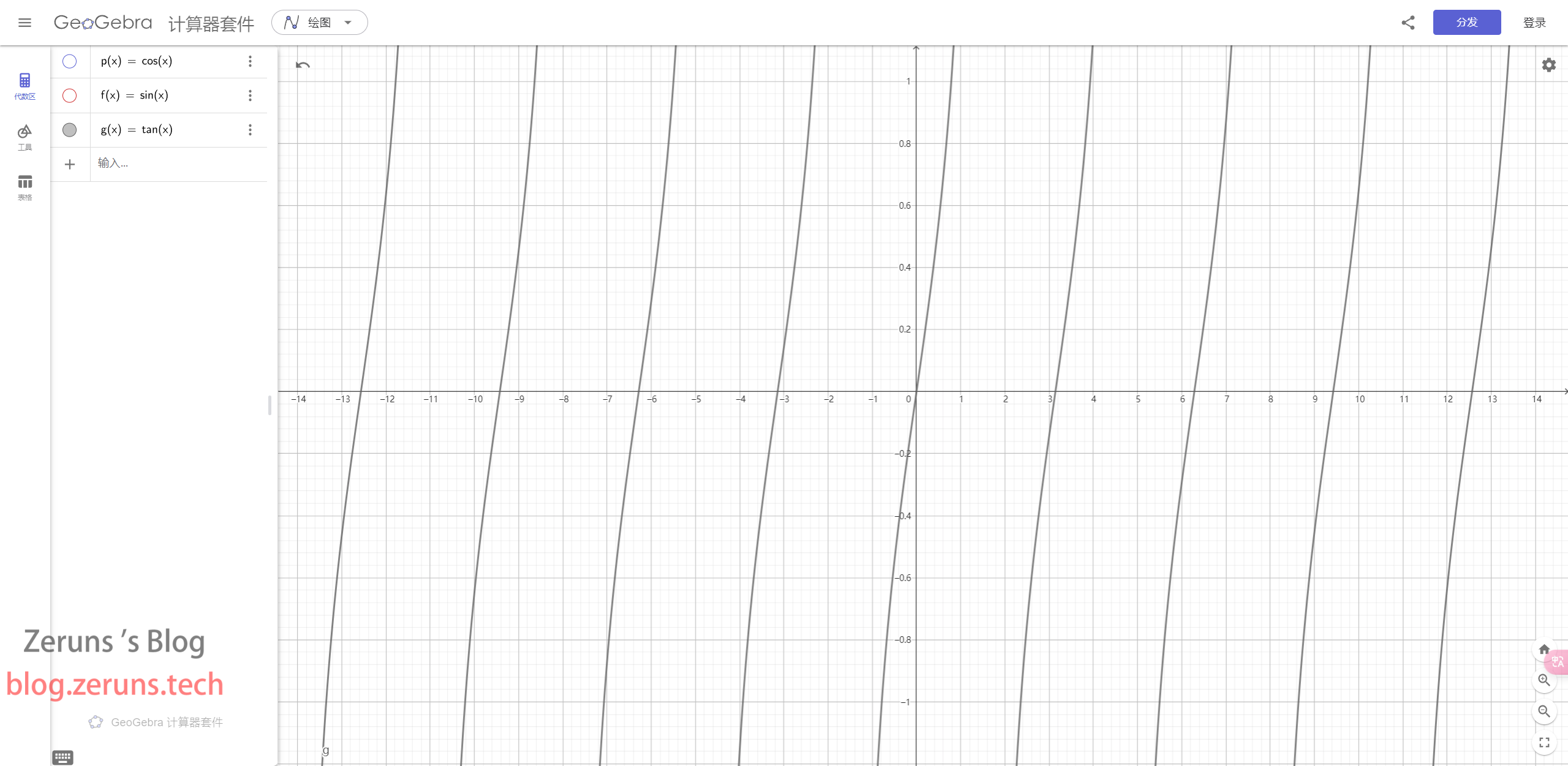
The graph of the tangent function is a periodic waveform with period \pi . It has vertical asymptotes at each point \theta = \frac{\pi}{2} + k\pi , where k is any integer. At these points, the function tends toward positive or negative infinity.
Relationships Between Tangent and Other Trigonometric Functions
The tangent function has many important relationships with other trigonometric functions:
-
Basic Definition:
\tan(\theta) = \frac{\sin(\theta)}{\cos(\theta)} -
Reciprocal Relationship:
\cot(\theta) = \frac{1}{\tan(\theta)} = \frac{\cos(\theta)}{\sin(\theta)}
where \cot(\theta) is the cotangent function. -
Pythagorean Identity:
\sec^2(\theta) = 1 + \tan^2(\theta)
where \sec(\theta) = \frac{1}{\cos(\theta)} is the secant function. -
Sum and Difference Formulas:
\tan(\alpha \pm \beta) = \frac{\tan(\alpha) \pm \tan(\beta)}{1 \mp \tan(\alpha)\tan(\beta)} -
Double-Angle Formula:
\tan(2\theta) = \frac{2\tan(\theta)}{1 - \tan^2(\theta)}
Applications of the Tangent Function
The tangent function is applied in various fields, especially in:
- Geometry: In right triangles, the tangent function represents the ratio of the opposite side to the adjacent side.
- Physics: Used to describe waves, vibrations, and slopes.
- Engineering: Used in signal processing, communications, and control systems to analyze and process periodic signals.
- Navigation and Astronomy: Used to calculate angles and distances.
Summary
The tangent function is a periodic function with many important properties and applications. Understanding and mastering the tangent function is essential for solving various mathematical and engineering problems.
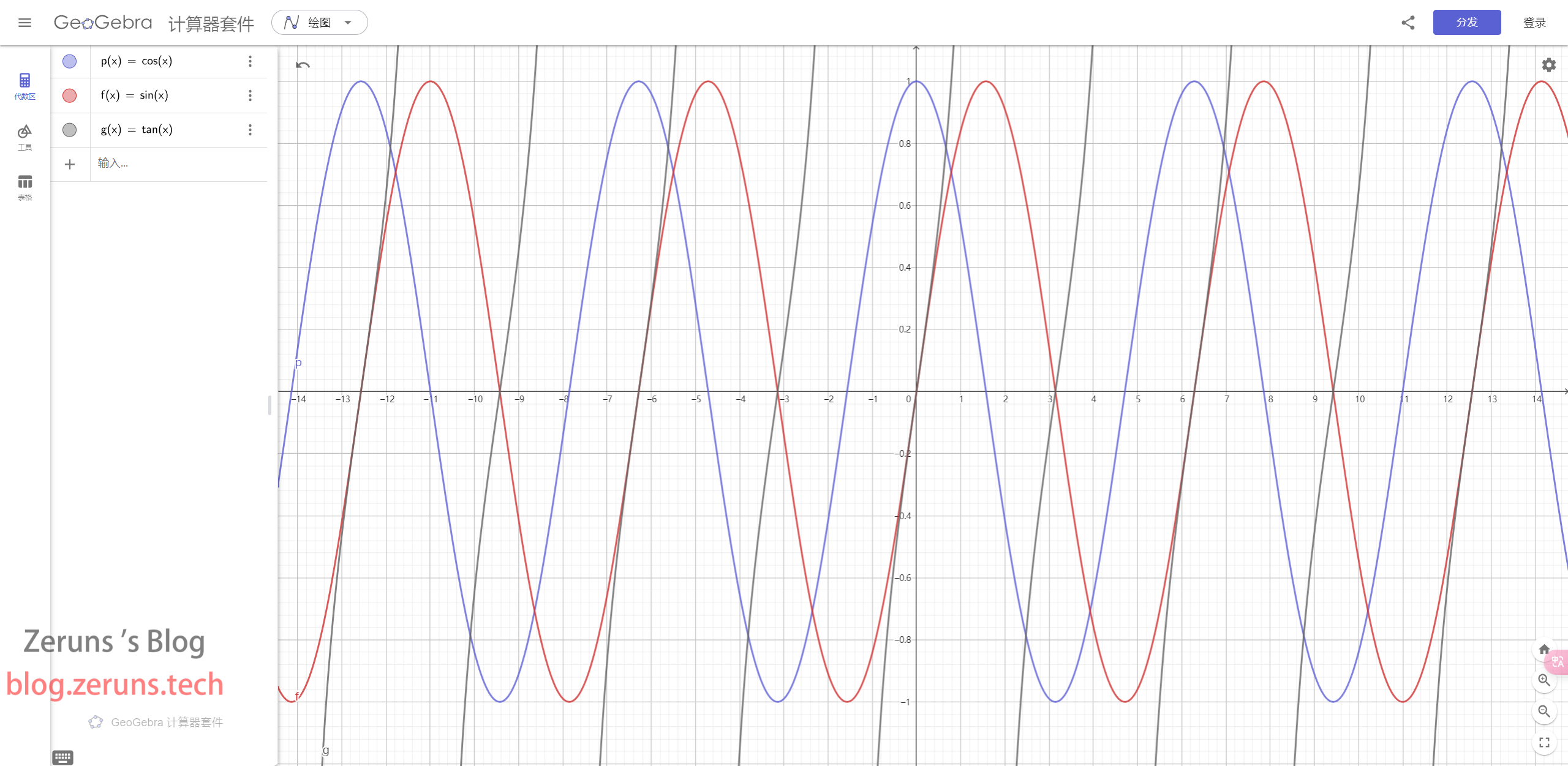
Graphs of the Three Functions
Recommended Articles
- Recommended High-Value and Affordable VPS/Cloud Servers: https://blog.zeruns.com/archives/383.html
- Minecraft Server Setup Guide: https://blog.zeruns.com/tag/mc/
- Disassembly and Analysis of the Redes D1500 UPS: https://blog.zeruns.com/archives/792.html
- Open-Source Synchronous Buck-Boost Digital Power Supply Based on STM32: https://blog.zeruns.com/archives/791.html
- Unboxing and Imaging Performance of the Uni-T UTi261M Thermal Imaging Camera: https://blog.zeruns.com/archives/798.html
- Open-Source 140W+65W Buck-Boost PD3.1 Fast Charger (2C+1A Ports), IP6557+IP6538, 205W Desktop Charger: https://blog.zeruns.com/archives/801.html
Disclaimer
This article was generated by AI and manually verified to be essentially accurate.