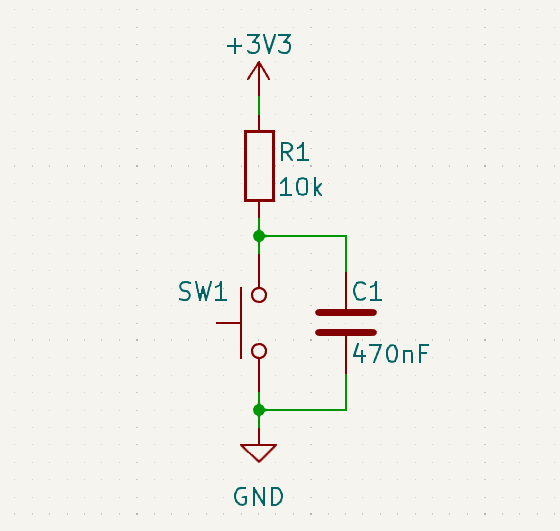
Keystroke Hardware RC Debounce Circuit Value and Charging/Discharging Time Calculation

I. Core Principle and Value Selection Criteria of RC Debouncing

The essence of mechanical button debouncing lies in utilizing the charging and discharging inertia of an RC (resistor-capacitor) circuit to smooth out voltage spikes caused by mechanical bouncing during button press or release, thereby filtering out unwanted noise. The commonly used circuit connects a pull-up resistor R in parallel with a capacitor C across the button terminals. The key parameter is the RC time constant:

\boldsymbol{\tau = R \times C}
  • \tau: RC time constant, measured in seconds (s); it represents the time required for the capacitor’s voltage to charge/discharge to 63.2% of its steady-state value;
  • In engineering practice, the circuit is considered to have reached over 99% of steady-state and fully filtered out bounce after \boldsymbol{5\tau} ;
  • Typical tactile buttons exhibit mechanical bounce durations of 5–20 ms. To ensure reliable debouncing, we require \boldsymbol{5\tau \geq 20\,\text{ms}} , which implies \boldsymbol{\tau \geq 4\,\text{ms}} .

II. Recommended Capacitance Values for a 10kΩ Pull-Up Resistor

Given a pull-up resistance of R = 10\,\mathrm{k}\Omega = 10 \times 10^3\,\Omega , and requiring \tau \geq 4\,\mathrm{ms} = 4 \times 10^{-3}\,\mathrm{s} , the minimum capacitance can be derived as:

C_{\text{min}} = \frac{\tau}{R} = \frac{4 \times 10^{-3}}{10 \times 10^3} = \boldsymbol{400\,\mathrm{nF}}

Considering standard electronic component nominal values, the recommended capacitors for use with a 10kΩ pull-up resistor are:

Capacitance Nominal Value Corresponding RC Time Constant \tau 5\tau Full Debounce Time Applicability
220nF 2.2ms 11ms Weak filtering; only suitable for high-quality buttons with minimal bounce
470nF 4.7ms 23.5ms Meets debouncing requirements for most buttons; commonly used in engineering
1μF 10ms 50ms Strong debouncing effect but slower button response; suitable for applications insensitive to response speed

Conclusion: When using a 10kΩ pull-up resistor, prefer a 470nF capacitor, which balances effective debouncing and acceptable button response speed.

III. Charging/Discharging Time Calculation for 10kΩ + 470nF

Substituting into the formula for precise calculation:

  1. RC Time Constant
\tau = R \times C = 10 \times 10^3\,\Omega \times 470 \times 10^{-9}\,\mathrm{F} = \boldsymbol{0.0047\,\mathrm{s} = 4.7\,\mathrm{ms}}
  1. Complete Charge/Discharge and Reliable Debounce Time

To reach over 99% of steady-state, the circuit requires 5\tau:

5\tau = 5 \times 4.7\,\mathrm{ms} = \boldsymbol{23.5\,\mathrm{ms}}

This duration significantly exceeds the maximum 20ms bounce period of typical buttons, ensuring complete elimination of mechanical bounce while avoiding noticeable input lag.

IV. Practical Application Notes

  1. Prefer ceramic or monolithic capacitors, which offer good stability and low cost. Avoid electrolytic capacitors (polarized, poor high-frequency performance).
  2. If the microcontroller’s IO pin has an internal pull-up resistor enabled, the external 10kΩ resistor can be omitted—simply connect the capacitor directly across the button terminals.
  3. RC hardware debouncing is a passive filtering method and may not eliminate extreme bounce under all conditions. For high-reliability applications, combine it with software debouncing (e.g., reading the IO level, delaying 10–20ms, then reading again) to achieve dual-stage debouncing.

Software debouncing can also be used; a key state machine can implement functions such as button debouncing, short press, long press, and double-click.