Why does the Vds waveform of a flyback power supply oscillate in the latter part under DCM mode?

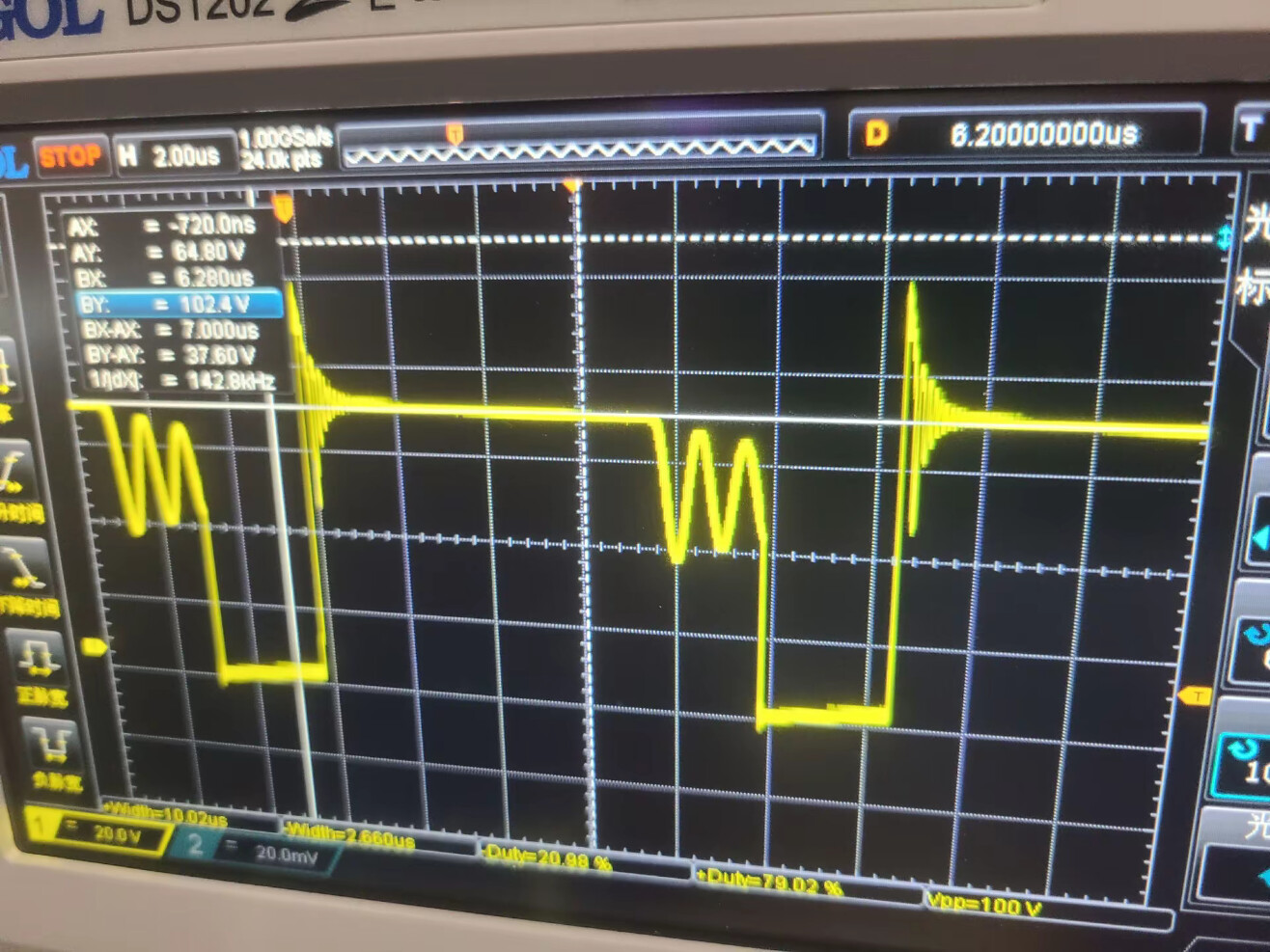
Why does the Vds waveform of a flyback power supply oscillate in the latter portion under DCM mode, as shown in the figure below?

The core concept is “disappearance of secondary clamping + primary LC resonance,” and the logic is quite clear:

In DCM mode, when the secondary current decays to zero, the secondary rectifying diode turns off automatically—this means the secondary can no longer reflect the output voltage to the primary side via the transformer turns ratio. In other words, the “voltage clamping effect” of the secondary on the primary disappears.

Meanwhile, on the primary side, there is still leakage inductance (inductance not coupled to the secondary), which, together with the MOSFET’s own parasitic capacitance (Coss), forms an LC resonant circuit. The remaining energy in the leakage inductance oscillates back and forth between the leakage inductance and the parasitic capacitance, causing oscillations in the Vds waveform. Because damping elements such as the resistor in the RCD snubber circuit and the on-resistance of the MOSFET dissipate energy, the oscillation amplitude gradually decays until all the energy is consumed.

Simply put: once the secondary loses control over the primary voltage, the primary-side leakage inductance and parasitic capacitance start “freely oscillating.”

3 Likes

In DCM mode, the secondary current drops to zero when the secondary inductive current reaches zero. This means that the energy in the transformer core has been completely released. As the diode current drops to zero, the diode automatically turns off, leaving the secondary side effectively open-circuited, and the output voltage is no longer reflected back to the primary side. At this point, since the MOSFET’s Vds voltage is higher than the input voltage, the difference in voltage causes the MOSFET’s junction capacitance and the primary inductance to resonate. The resonant current discharges the junction capacitance of the MOSFET. The Vds voltage begins to decrease, and after a quarter of a resonant cycle, it starts rising again. Due to the presence of the RCD clamp circuit and other parasitic resistances, this oscillation is damped, with decreasing amplitude over time.

1 Like

That oscillation is a classic characteristic of DCM operation. It’s caused by the primary magnetizing inductance of the transformer resonating with the total parasitic capacitance at the drain of the MOSFET.

This “latter part” of the waveform is the “discontinuous” or dead-time period—the time after the secondary diode has finished delivering all the stored energy to the output and before the primary MOSFET turns on again.

Here’s a step-by-step breakdown of what’s happening:


1. The Key Components

The ringing is caused by a classic LC resonant tank circuit (or “tank”) being formed by two main components:

  • The Inductor (L): The primary magnetizing inductance (Lm) of the flyback transformer.
  • The Capacitor (C): The total parasitic capacitance at the switch node (C_node). This capacitance is the sum of several stray capacitances:
    • MOSFET Output Capacitance (Coss): This is the capacitance between the drain and source of the (currently-off) MOSFET. It’s usually the largest contributor.
    • Transformer Winding Capacitance (Cw): The capacitance between the primary winding’s turns.
    • PCB Layout Capacitance: Stray capacitance from the circuit board traces.

2. The DCM Switching Cycle

To see why this happens, let’s look at the three distinct phases of a DCM switching cycle:

  1. MOSFET ON: The switch is closed. Current ramps up in the primary magnetizing inductance (Lm), storing energy. The Vds (drain-source voltage) is near 0V.
  2. MOSFET OFF (Energy Transfer): The switch opens. The energy stored in Lm is transferred to the secondary side, and the output diode turns ON. The Vds jumps up to the input voltage (Vin) plus the reflected output voltage (V_reflected).
  3. MOSFET OFF (Dead Time): This is the crucial part. In DCM, the energy transfer finishes before the next cycle begins.
    • The secondary current drops to zero.
    • The output diode turns OFF.
    • At this exact instant, the transformer’s secondary is “disconnected” from the circuit. The primary side is also disconnected (since the MOSFET is off).
    • The primary magnetizing inductance (Lm) is now effectively in parallel with the total node capacitance (C_node).
    • The “kick” from the voltage rapidly changing as the diode turns off excites this LC tank, and it begins to oscillate (ring) at its natural resonant frequency: f_r = 1 / (2\pi \sqrt{Lm \cdot C_{node}})
    • This (usually damped) oscillation continues until the MOSFET turns on again for the next cycle.

3. Is This Ringing a Problem?

It can be, but it can also be an advantage:

  • The Bad (EMI): This ringing is a high-frequency oscillation, which can be a significant source of Electro-Magnetic Interference (EMI) that can cause the power supply to fail regulatory testing.
  • The Good (Valley Switching): Smart power supply controllers, known as Quasi-Resonant (QR) or Valley-Switching controllers, are designed to detect this oscillation. They intentionally turn the MOSFET back on when the Vds voltage rings down to its lowest point (the “valley”). This technique, called Zero Voltage Switching (ZVS) or “soft switching,” dramatically reduces switching losses and improves the converter’s overall efficiency.
3 Likes